7928
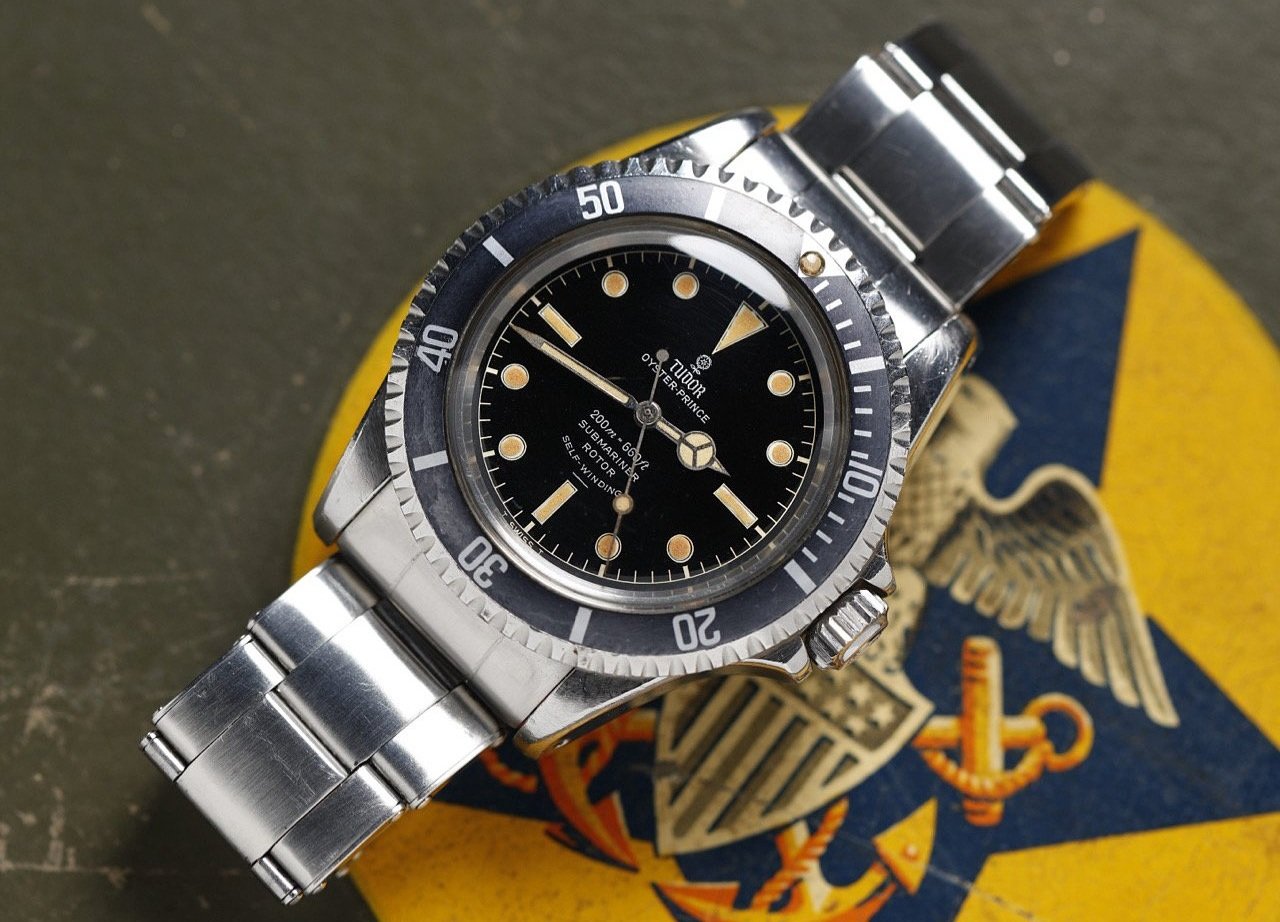
Tudor introduced the ref. 7928 in 1959, and it remained in continuous production for nearly a decade. With the 7928, Tudor implemented major changes, including the introduction of crown guards and an increased case size of 39mm (up from 37mm on the 7924). Over its production run, several case and dial variations emerged, making it the most diverse reference in the Tudor Submariner lineup. One constant, however, was the continued use of the modified Fleurier cal. 390 from earlier references.
Case - As mentioned earlier, the ref. 7928 was the first Tudor Submariner to feature crown guards, which evolved several times over the course of its production. A key influence on the case design was the French Navy. One of the main issues with the previous reference (7924) was the large, exposed 8mm crown, which was prone to impact underwater and could lead to water ingress, compromising the watch’s integrity. To address this, Tudor introduced crown guards and increased the case size to 39mm, resulting in a more robust and reliable design. The caseback was stamped “Original Oyster Case By Rolex Geneva.”
The earliest examples of the ref. 7928 were fitted with the extremely rare Square Crown Guards, with general consensus among collectors suggesting that only around 100 were produced. This was followed by the Eagle Beak variation, also made for a very short period, characterized by more tapered guards that terminate in a sharp point. After these two rare configurations, Tudor transitioned to Pointed Crown Guards and ultimately to Rounded Crown Guards.


From Left to right: Square Crown Guards, Eagle Beak, Pointed Crown Guards and Rounded Crown Guards
Hands - Early ref. 7928 examples were fitted with gilt hands through 1963, in line with gilt dial production. As Tudor transitioned to silver print dials, steel hands were introduced. Like their Rolex counterparts, Tudor hands remained flat in profile until around 1968, when the introduction of the Ref. 7016 coincided with the appearance of slightly curved hands. Over time, we also see the appearance of the “lollipop” seconds hand, though there is no clear consensus on when these left the factory.
Please note that the hands used on the 7928 are not interchangeable with those of the 5513 due to differences in mounting post sizes.
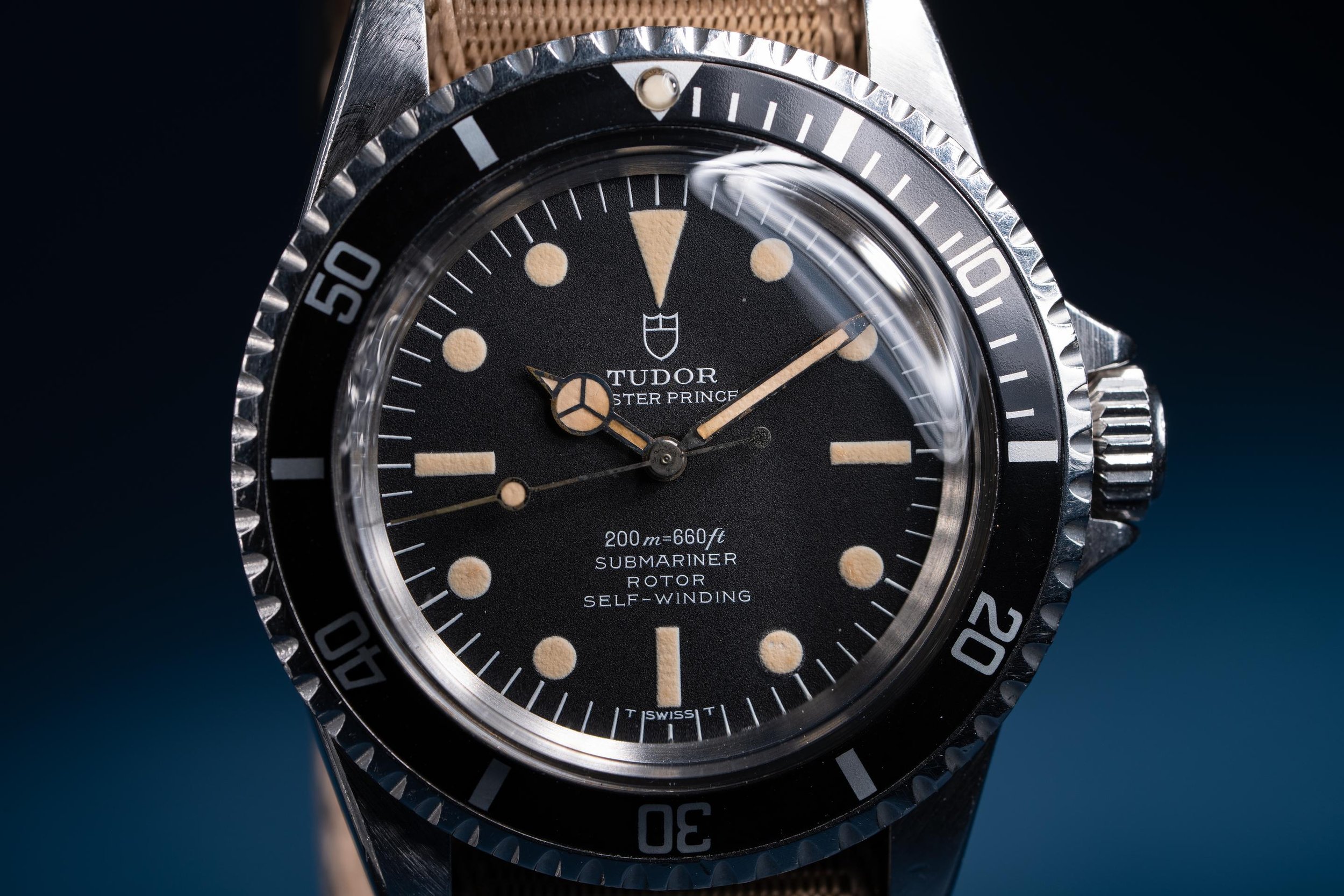
Dial - Unlike early Submariners produced by Rolex in the 1960s, Tudor largely opted for matte dials. One notable characteristic of these dials is the satin-like finish they developed over time. Within this reference, we also encounter exclamation and underline dials, as well as a short-lived glossy dial produced briefly in the mid-1960s.
Rolex and Tudor used exclamation and underline dials to denote the transition from radium to tritium in the early 1960s. The exclamation dial was the first to indicate this shift and is associated with lower levels of gamma radiation compared to earlier examples. It was soon followed by the underline dial, which signifies an even further reduction in radiation. Exclamation dials are generally observed within the 33xxxx–37xxxx serial range, while underline dials appear around 40xxxx–43xxxx.
The printed text on the dials remained consistent over the years. In the upper half, we find the Tudor rose with “Oyster-Prince” immediately below. The lower half features four lines: “200m = 660ft,” followed by “SUBMARINER,” then “ROTOR,” and finally “SELF-WINDING.” The upward curve of “SELF-WINDING” is a collector favorite and has inspired modern Tudor designs.
Please note that the serial ranges provided below are estimates and are not definitive.
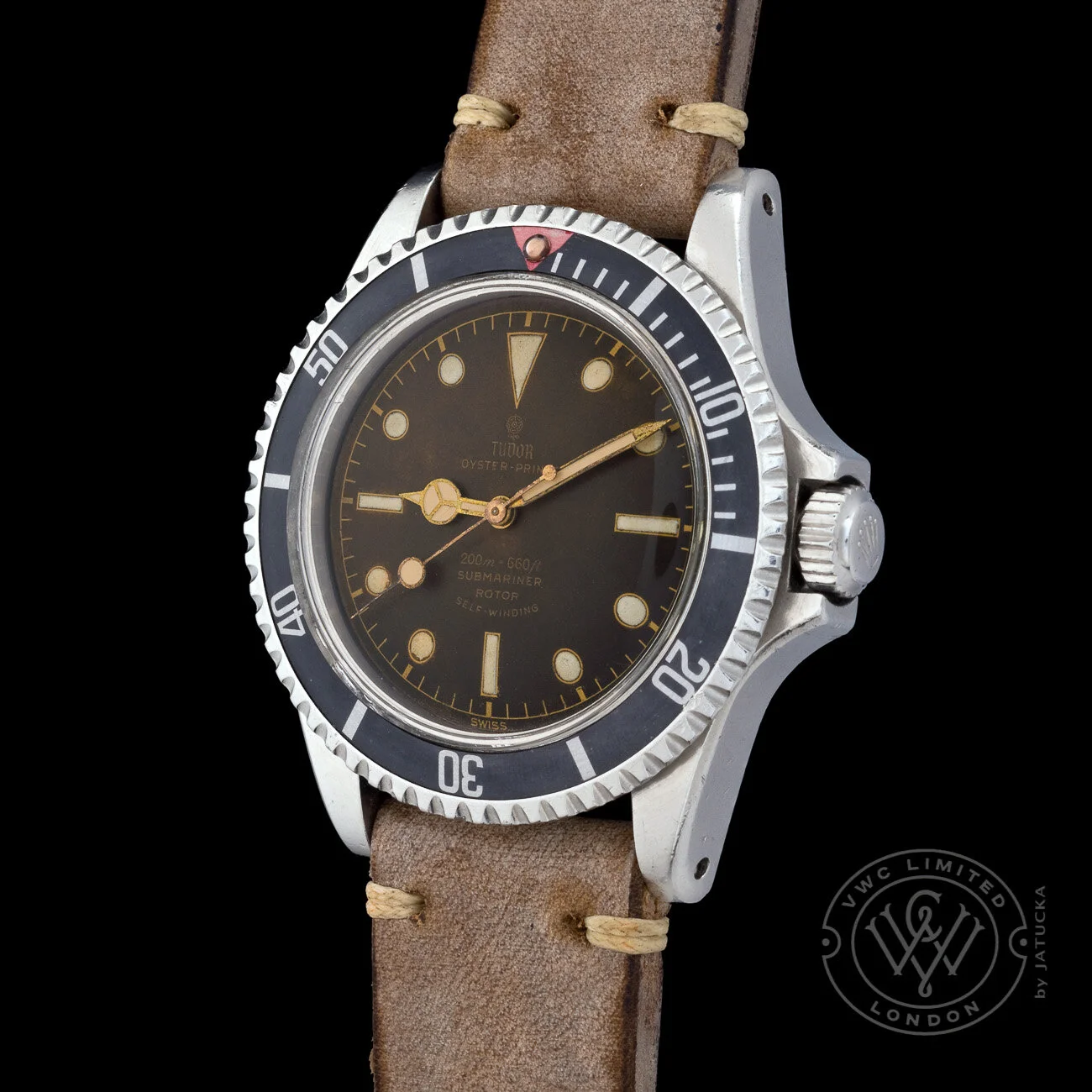


MK1
Gilt Chapter ring
Gilt Print
Gilt Hands
SWISS only
Square Crown Guards
Red Triangle Insert
Approx. serial range: 305xxx
Notes: There is a general consensus that only 100 or so Square Crown Guard examples exist.


MK2
Gilt Chapter ring
Gilt Print
Gilt Hands
SWISS only
Eagle Beak Crown Guards
Red Triangle Insert
Approx. serial range: 305xxx
Notes: MK2 shared the same dial design as the MK1 but with Eagle Beak crown guards. Speculation is that the Eagle Beak was cut down from Square Crown Guards and that only a couple hundred were produced.


MK3
Gilt Chapter Ring
Gilt Print
Gilt Hands
SWISS Only
Pointed Crown Guards
Approx. serial range: 325xxx to 409xxx
Notes: This is the first time we see Pointed Crown Guards. Exclamation dials are seen in this range, as well as the beginning of underline dials.

MK4
Gilt Chapter Ring
Silver Print
Rhodium Hands
SWISS only
Pointed Crown Guards
Approx. serial Range: 40xxxx to 409xxx
Notes: This is the first time we see silver print. The silver print dials were first used on the Pointed Crown Guard before transitioning to a Rounded Crown Guard case. Underline dials are found on the MK4.


MK5
Gilt Chapter ring
Silver Print
Rhodium Hands
T Swiss T
Rounded Crown Guards
Approx. serial Range: 409xxx to 568xxx
Notes: Underline dials are found in this serial range.


MK6
Open Chapter
White Print
Rhodium Hands
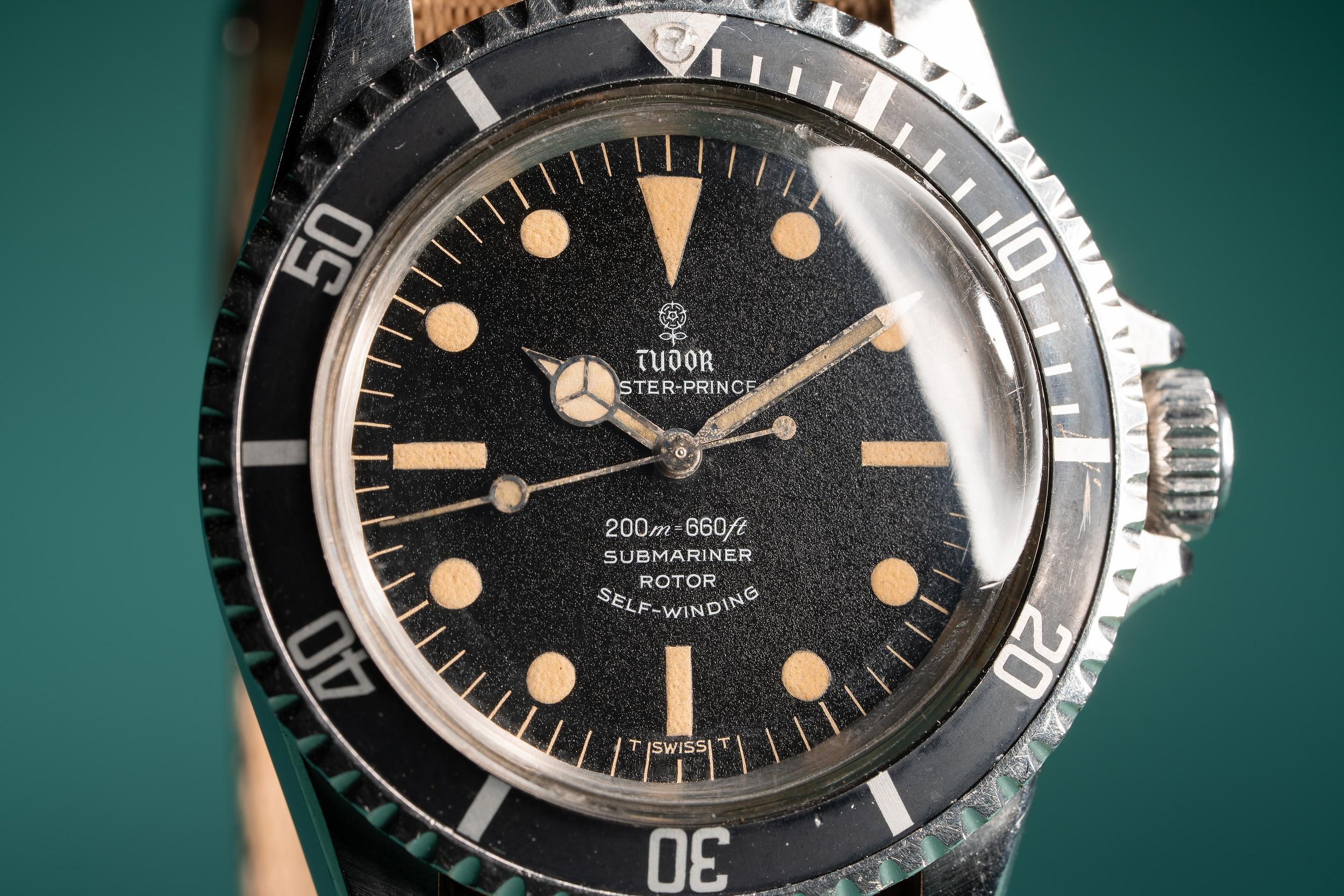
Glossy Dial
T SWISS T
Rounded Crown Guards
Gilt Hash Marks
Approx. serial range: 506xxx to 598xxx
Notes: Tudor briefly produced glossy dials during the 7928 era. Most documented examples are dated to 1966, bearing a “VI 66” caseback stamp. That said, a number of examples with 1965 casebacks have surfaced, including a few from original owners. This represents Tudor’s first use of glossy dials within the Submariner line. The brand would soon return to matte dials for the remainder of 7928 production, only reintroducing gloss in the 1980s. Notably, the shift to an open chapter ring also coincided with a transition from silver to white dial printing.
Tropical Watch
MK7
Open Chapter
White Print
Rhodium Hands
T SWISS T
Rounded Crown Guards
Gilt or white Hash Marks
Approx. serial range: 570xxx to 598xxx
Notes: This is the final dial variation of the 7928 before Tudor transitions to the 7016/0 and 7021/0.
SERVICE DIALS
The shield dial was a common service replacement for the 7928, coming in both a two and four line version.