The History Of Tudor And The Royal Canadian Navy
It is well known that in the mid-20th century, Tudor had connections with a number of military organizations around the world. The most recognized was with the French Navy, the Marine Nationale (MN), recently revisited with the release of the Pelagos FXD - a watch developed with input from the MN’s combat swimmers, the Commando Hubert. Tudor also supplied watches to other military organizations, including the U.S., South African, and Argentinian navies. While collectors have documented many of these relationships, one with deep historical significance remains underexplored - the Royal Canadian Navy (RCN).

Ships diver course 7102
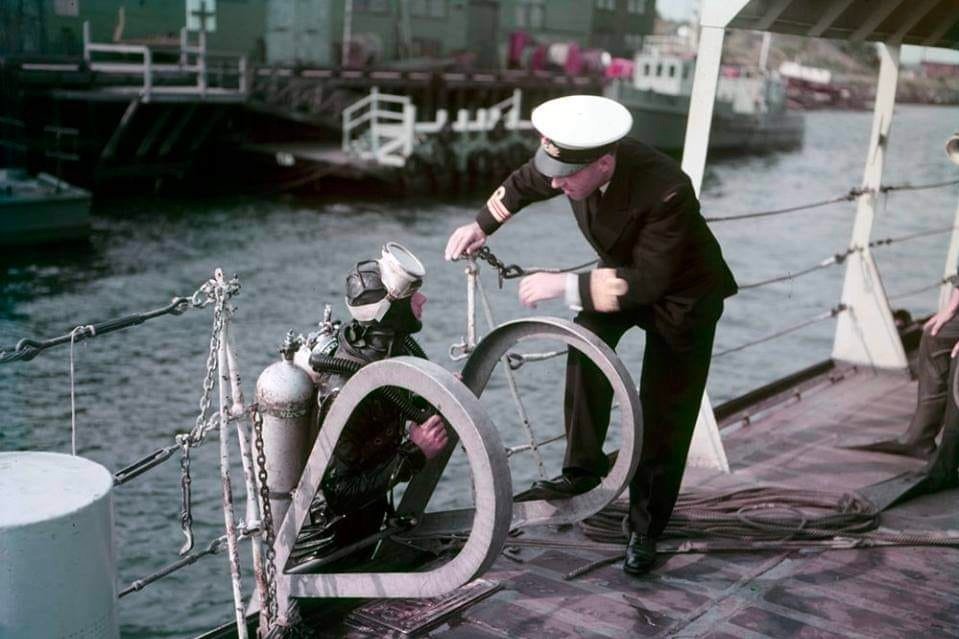
Tudor’s relationship with the RCN officially began in the late ‘60s. However, there is evidence that Tudors were being used by the RCN in the late ‘50s. Initially, these watches were reserved for higher-ranking officials, but by the early to mid-‘70s this changed, and the RCN began supplying Tudors to ship-based diving units. Much like a wetsuit, regulator, knife, or tank, a diver was issued a watch as part of their kit.
While the relationship between Tudor and the RCN has long been known, it has also been shrouded in mystery, lacking the first-hand accounts collectors value most. With the help of several servicemen and their watches, I’ve been able to better document this history and address questions that have confounded collectors for years - particularly surrounding the “Hybrid,” a historically significant and perhaps one of the rarest Tudor Submariners.
“I lost a few fighting sharks (and) getting hung up on Russian nuclear subs...”
The Story of Tudor And The RCN, From The Men Who Were There
A few years back, a diver reached out looking for information on a Tudor he had been issued as an RCN diver in the ‘70s. During our conversation, he mentioned, “As a trade diver, some equipment was issued to me personally - boots, uniform, dry suit, watch, etc. My unit was given six watches. Four had blue dials and two were black. I had first pick and went with the brand new blue one,” referring to a Tudor “Snowflake,” ref. 94010.
When he retired from service, he returned all of his equipment except for the Tudor. He told the RCN he had lost it. When they attempted to charge him, he removed the Bulova he was wearing and handed it over as payment. When asked why he kept the Tudor, he replied, “I loved that watch. It was tough as hell.”
Notably, the watch was his to keep until he left service. The process of personally issuing Tudors to divers didn’t last long, though. By the 1980s, the RCN had shifted to a new distribution system. This came from my conversation with Tim Flath, who served 22 years as a Naval Officer (retired as Lieutenant Commander) in the RCN, specializing in Navy Diving and Explosive Ordnance Disposal. I first got in touch with Tim after coming across his website - a resource for active and retired divers to stay informed and connected with others who served. Tim was kind enough to share his experience in the RCN, along with the watches issued to him and his unit. “The watches were held on a Distribution Account (DA) at each military unit that held an entitlement based on the number of divers on strength. I had a 12-person dive team so was only entitled to six Tudor watches on my account as the Diving Officer in charge.” He went on to explain, “When you needed the gear, you signed it out, did the dive, then came back in and returned it.”
This new system of tracking provided better control and oversight of the equipment in use. Given the RCN was a small organization with limited funds, this approach made sense. Costs were also managed by keeping the same watches in rotation over the years. This practice continued for decades, with Tudors from the ‘60s and ‘70s still being worn by divers well into the ‘80s and ‘90s. By then, many were keeping poor time due to a lack of servicing, rendering them largely ineffective. “They were not good watches!” Tim laughed. “Not one of them on my DA kept decent time, and we had no budget to maintain them.” A recurring theme among the dozen or so divers I spoke with.
Regardless of how well they kept time, these Tudors carried significant value - and the divers knew it. As a result, watches were frequently “lost.” While not referring to his specific unit, Tim admitted this was a common occurrence. When it happened, protocol required the diver to file a loss report, followed by an investigation by the Commanding Officer. If found at fault, the diver could be held financially responsible. In practice, this was rare, as a watch was easy to lose during a dive. As one diver explained, “Diving is hard on gear and impossible to find when the pin breaks and sinks to the bottom of the ocean.” He then added, “So many at the bottom of the ocean, so very, very many.” Sensing the sarcasm, I considered pressing further, but given the watches were government property, it was clear that was all I was going to get. That impression was reinforced when another diver said, “So you're asking a group of pirates if they kept their Tudor? Yar!!!”
But my favorite response came from another diver: “They were hard to keep on your wrist. I lost a few fighting sharks, getting hung up on Russian nuclear subs, even rescuing my CO twice in one exercise when the Qu’Appelle went aground.”
After several conversations with different divers, it became clear I wasn’t meant to know what was true or not - and I was okay with that. For me, these absurd, almost fantastical stories lend the watch a mystique that feels as much a part of it as its uniquely shaped hands. Tim, on the other hand, was willing to share more.
When asked about the watches supplied by the RCN, Tim said, “they were mostly all different. The hour and minute hands were of varying styles, if I recall.” To better understand what was issued, I sent him photos of the different variations from this period, including one of a rarer configuration with mismatched plots and hands. He immediately recognized it and confirmed he had owned one for a short period of time. In fact, he had two and gifted one to a fellow diver. The watch was the RCN “Hybrid.”
The RCN “Hybrid”
This particular variation featured the traditional snowflake hands but was paired with round and rectangular hour markers and same-sized hash marks around the dial, akin to a radial dial. Collectors have come to refer to this dial configuration as the “Hybrid” given its mismatched plots and hands. Flip the watch around and you’ll find that Tudor also introduced a different case design for submariners that featured a deeper, more-pronounced groove around the mid-case than previously found on other models. As with other variations of the 94010, the “Hybrid” features the same caliber 2776, equipped with a hacking mechanism. The production window for the “Hybrid” is very narrow, with examples falling within the 86xxxx to 89xxxx serial range, often with consecutive numbers.
The significance of the “Hybrid’s” unique design is undeniable. Its influence is evident in Tudor’s Black Bay lineup, leading collectors to nickname it the “Black Bay Ancestor.”
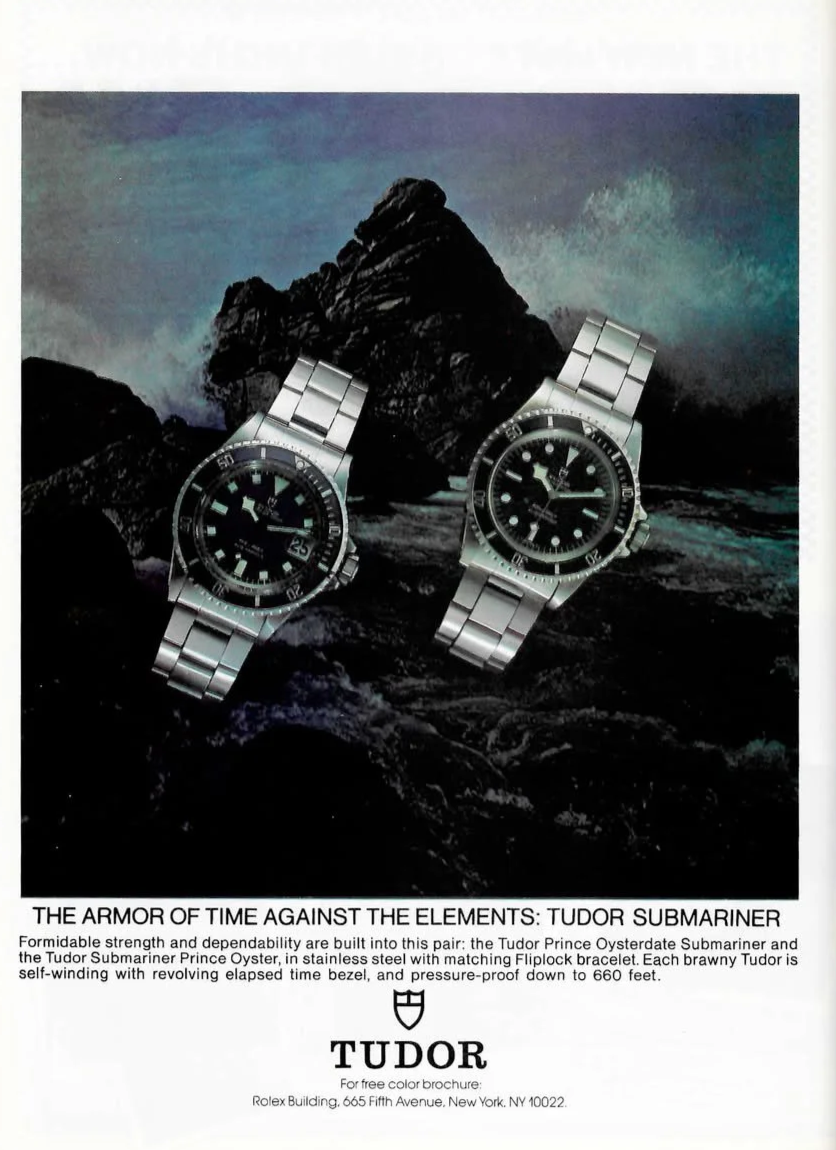
An advertisement featuring the “Hybrid” surfaced, leading to speculation that Tudor may have offered this configuration in its catalog. Tudor’s website notes that “…watches delivered to these military organizations were neither custom-designed nor specially developed. They were just references listed in the catalog, which these organizations chose.” So, was this configuration also available to civilians? According to Tudor, yes - which is why not all “Hybrids” should be assumed to have RCN ties. The serial, among other factors, can offer clues, but an RCN “Hybrid” should only carry that designation if supported by provenance.
As you can imagine, this is difficult to prove. The configuration features a sterile caseback, and there is no known ledger or database to confirm military ties, as exists with the MN. Perhaps one will surface one day - that would be the ideal scenario for the collecting community. Until then, sourcing a “Hybrid” directly from an original RCN diver remains the only reliable way to establish its legitimacy.
During my research, one thing that stood out was that the RCN appears to be the only military organization to have received this configuration of Tudor Submariners. Every other, including the MN, were supplied the same type of submariners. The reason remains unclear, but the fact that the RCN received a batch of watches with a new dial makes this, in my opinion, one of the most important Submariners produced by Tudor. It also happens to be one of the rarest.
Prem Chainani, a Swiss-trained watchmaker based in Canada - who has likely handled more RCN Tudors than anyone else - estimates that approximately 200 “Hybrids” were issued to the RCN. What survives today is another story. Current estimates suggest that only a couple dozen examples still exist, with just a handful carrying confirmed military provenance.
Unfortunately, many “Hybrids,” along with other Tudor Submariners, were ultimately destroyed. More on that shortly.
The RCN Connection In The ‘80s and ‘90s
The RCN continued issuing the ref. 94010 through the end of its production run in ’84. Several batches were delivered toward the end of this reference: 203xx, 100xxx, 101xxx, and 107xxx. All of these late batches - excluding 203xx - featured the final dial configuration of the 94010, with Mercedes hands and round hour markers with triangular plots at 3, 6, 9, and 12 o’clock. The 203xx batch, however, retained a Snowflake dial. While most examples from this batch featured a sterile caseback, some were engraved by the RCN rather than the diver, which was common at the time.
The last Tudors supplied to the RCN were the ref. 76100 and 79090. After this, the RCN transitioned to other brands, such as Seiko and Marathon, ending a partnership that had spanned nearly five decades.


The End of an Era
The phasing out of Tudor in favor of Seiko and Marathon was most likely due to cost, though the transition also coincided with the RCN evaluating its use of radiation hazard (RADHAZ) equipment and diving instrumentation. While not definitively confirmed, some accounts suggest that concerns around radium exposure prompted a recall of Tudor Submariners. Many of these watches are believed to have been destroyed, contributing to the rarity of surviving RCN-issued examples.
Going down the RCN/Tudor rabbit hole led me to Tim and several other divers, whose accounts added important context to these watches. Understanding how they were used - and the environments they were used in - offers a perspective that goes beyond what documentation alone can provide. For those who still have them, these watches are more than tools - they’re a direct link to their time in service.
Happy hunting.