Hands
Handsets on vintage Tudor Submariners evolved much like the watches themselves - beginning in close alignment with Rolex before gradually establishing a distinct identity. Early references were fitted with traditional Mercedes hands, and in some cases pencil hands, mirroring the designs found on contemporary Rolex Submariners. By the late 1960s, however, Tudor introduced the now iconic snowflake handset, a purposeful shift that emphasized legibility and functionality. Developed in response to military requirements, the larger luminous surfaces of the snowflake design improved visibility in low-light and underwater conditions, ultimately becoming one of the defining characteristics of the Tudor Submariner.
While the change may appear subtle at first glance, it fundamentally altered the character of the Tudor Submariner and marked a clear departure from its Rolex-inspired origins. In this section, we examine the progression of Tudor Submariner handsets across two distinct periods: the Pre-Snowflake era (1950s–late 1960s) and the Snowflake era (late 1960s onward), with a brief look at the distinctive lollipop hour hand that succeeded the 94-series reference.
Pre-Snowflake (1950’s - late ‘60’s)
At the introduction of the Tudor Submariner, the handsets closely mirrored those found on contemporary Rolex Submariners. However, due to differences in hole diameters, Tudor and Rolex hands are not directly interchangeable - a distinction that remained true throughout the entire Tudor Submariner production run. Throughout the Mercedes-hand era, Tudor consistently used hour and seconds hands measuring approximately 12.5mm, whereas Rolex Submariners can be found with both 12.5mm and 13mm hour and seconds hands, typically corresponding to big crown and small crown references, respectively. 12mm became the standard for Rolex when they transitioned to an open chapter ring dial.
Gilt hands were used until approximately 1963, after which Tudor transitioned to rhodium hands for the remainder of the Mercedes-hand production period. Like their Rolex counterparts, Tudor hands remained flat in profile until around 1968, when the introduction of the Ref. 7016 coincided with the appearance of slightly curved hands.
Tudor 7923 with pencil hands
Tudor 7924 w/ traditional mercedes hands
Snowflake Era (late ’60s onward)
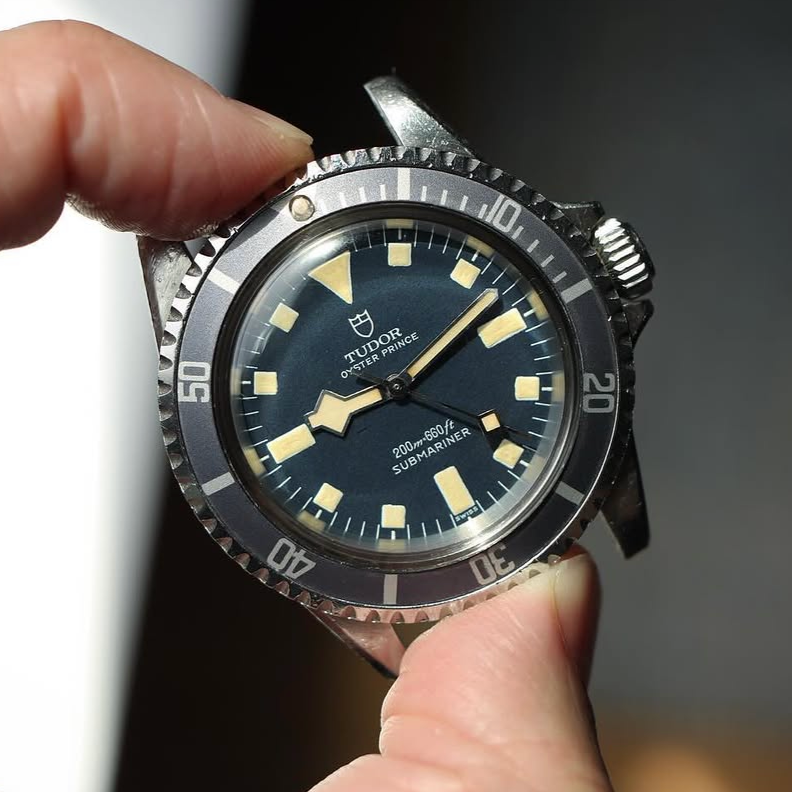
Tudor 7016/0 Snowflake - “Swiss Only”
This is where Tudor began to establish a distinct identity of its own. In 1968, the brand introduced what would become its most defining design feature - the now iconic snowflake handset.
Square “snowflake” hour hand
Broader sword-style minute hand
Larger lume surfaces across all hands
Paired with square lume plots on the dial
The focus shifts clearly toward legibility and function, giving Tudor a more tool-driven aesthetic and marking a real departure from Rolex design. Introduced in 1968 and influenced by Tudor's work with the French Navy, where improved underwater legibility was critical, the Snowflake handset signaled a new direction for the brand and helped establish a distinct identity. Snowflake hands were rhodium-finished throughout their production, although subtle variations existed between references. Notably, Snowflake hands from the Ref. 7016 and 7021 are not interchangeable with those used on the later 94-series references due to differences in the center seconds pinion tube diameter.
It’s arguably the defining feature of Tudor ever since, with much of the modern lineup returning to the same design. While Tudor did revert back to the traditional Mercedes-style handset toward the end of the 94 series and for a period after, the snowflake has ultimately become the signature.
The ref. 76100 - “Lollipop”
Bazamu
Introduced around 1984, the reference 76100 succeeded the 94110 and marked a transitional period in the evolution of the Tudor Submariner. Produced for only a brief time, it is best known for its distinctive "lollipop" hour hand - a unique handset configuration within the Tudor Submariner lineage.
Neither fully Snowflake nor directly derived from contemporary Rolex Submariners, the 76100 represents a unique chapter in Tudor's design evolution. As for whether it appears only on the 76100, that's where things get murkier. The lollipop hour hand is most commonly documented on the ref. 76100 but can also be found on some early 79090 examples.