Case
At first glance, vintage Tudor Submariner cases appear nearly identical to their Rolex counterparts. This is hardly surprising, as Tudor sourced many of its external components directly from Rolex. Yet a closer examination reveals a number of subtle differences that help define the Tudor Submariner on its own terms.
Although Tudor and Rolex Submariners shared the same overall case dimensions throughout much of their production, they often wear differently on the wrist. A significant contributor to this difference is the caseback design. Early Tudor references are typically found with flatter casebacks that sit closer to the wrist, resulting in a slimmer overall profile than comparable Rolex Submariners. This may have been influenced by the use of thinner ETA- and Fleurier-based movements, which required less internal clearance than contemporary Rolex calibres.
While manufactured by Rolex, Tudor casebacks are distinct and not interchangeable with their Rolex counterparts. They are typically characterized by a flat central channel, whereas comparable Rolex Submariners often feature a more pronounced external dome, or "bump.” As the Tudor Submariner evolved, later references such as the 94-series and Ref. 76100 adopted more pronounced casebacks, gradually bringing their wrist presence closer to that of contemporary Rolex models.
Despite sharing many external dimensions, these subtle differences in case construction contribute to the distinct wearing characteristics of Tudor and Rolex Submariners.
ref. 5513 - Watches of Knightsbridge
ref. 7016 - Watches of Knightsbridge
Crowns, crown guards and casebacks represent another area where Tudor's relationship with Rolex is most visible. Throughout much of the Submariner's production, Tudor utilized Rolex-manufactured components bearing the familiar Rolex markings found on contemporary Rolex Submariners. Following the use of Brevet crowns on the earliest references, Tudor adopted Rolex's 700 Twinlock crown before later transitioning to the 702 Twinlock and eventually the 703 Triplock crown as water-resistance technology evolved. Likewise, many Tudor Submariner casebacks were manufactured by Rolex and carry the same internal Rolex signatures found on period Rolex references.
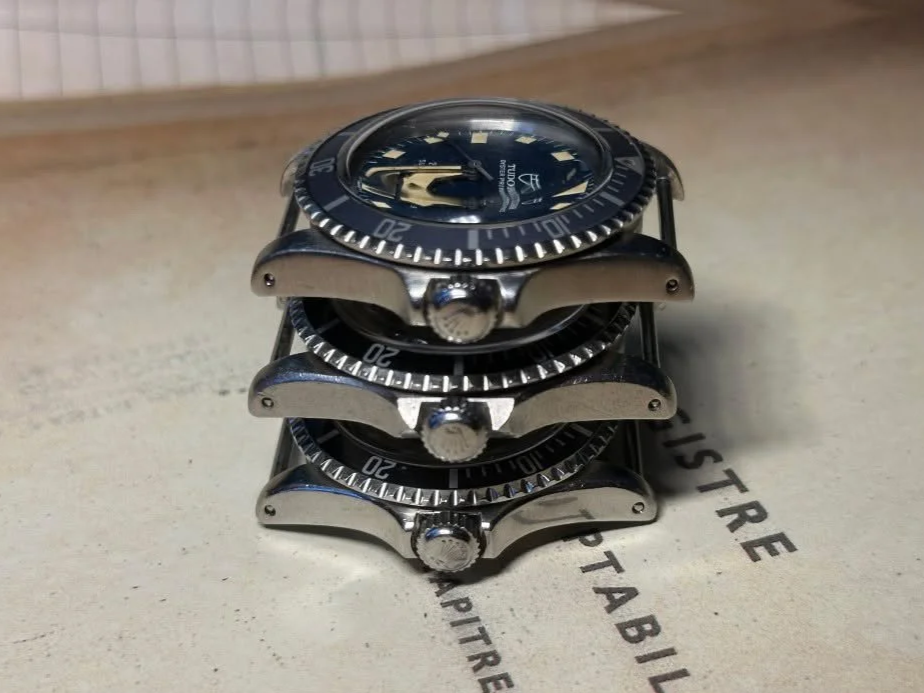
@vintagerolextudor
One notable difference occurred in 1968, with the introduction of the Ref. 7016. These watches were fitted with what collectors refer to as semi-pointed crown guards (SPCG) - a transitional and short-lived crown guard profile that bridges the gap between the pointed guards of the early- to mid-1960s and the fully rounded crown guards that became standard in later years. The tips retain a distinct taper toward the crown but are broader and less acute than true pointed crown guards (PCG). Likewise, the inner edges preserve some angularity, while the outer profile begins to adopt the softer contours of later cases. Tudor subsequently reverted to rounded crown guards, a design that had also been used immediately prior to the introduction of the SPCG case.
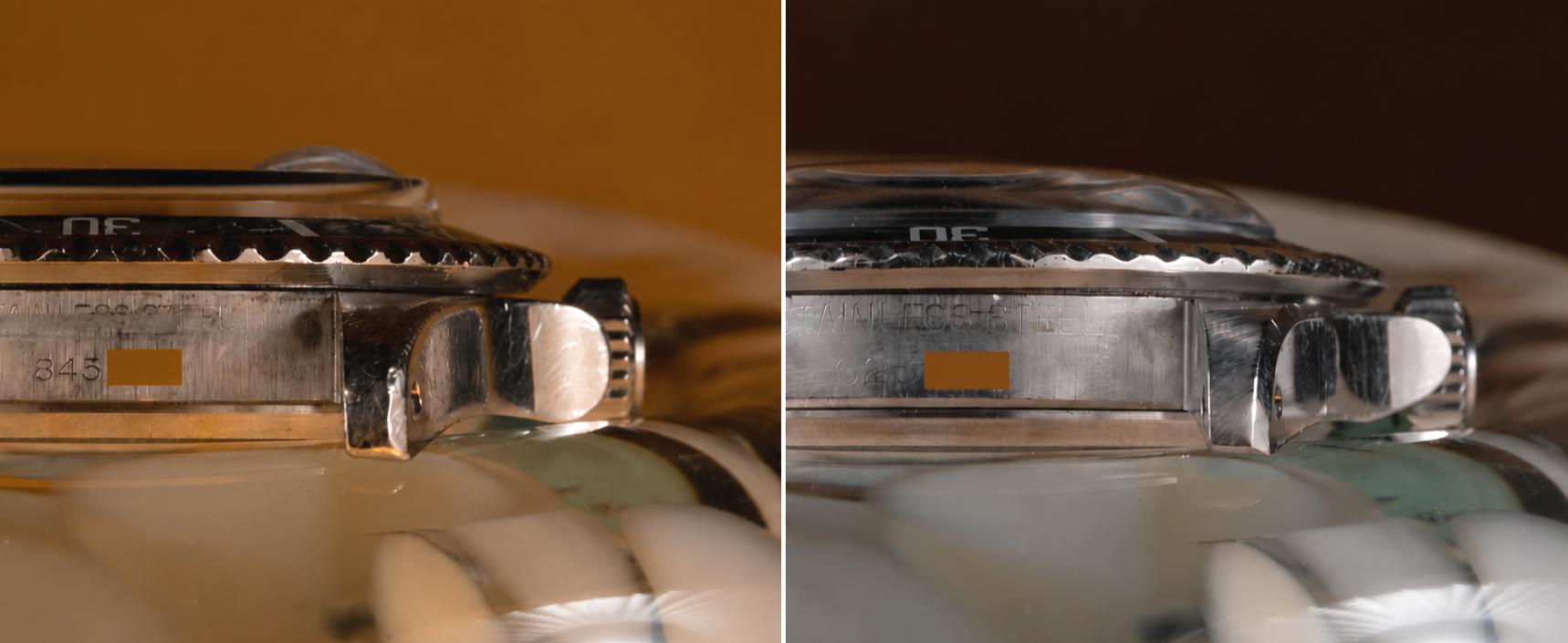
Round vs semi-pointed crown guards - Tropical Watch
Taken together, these differences help distinguish the Tudor Submariner from its Rolex counterparts. While the two brands shared a common foundation, Tudor gradually developed a character of its own - one defined by subtle variations that are increasingly appreciated by collectors today.
Additional details on the case, crown and caseback can be found in the REFERENCES section of the site.